A voice message becomes a task with a due date
The tiring part of a long voice message is rarely the listening. It is what comes after: remembering what had to be done, and by when. VoiceClue takes that part off your hands — and tells you, for every single item, where it got it from.
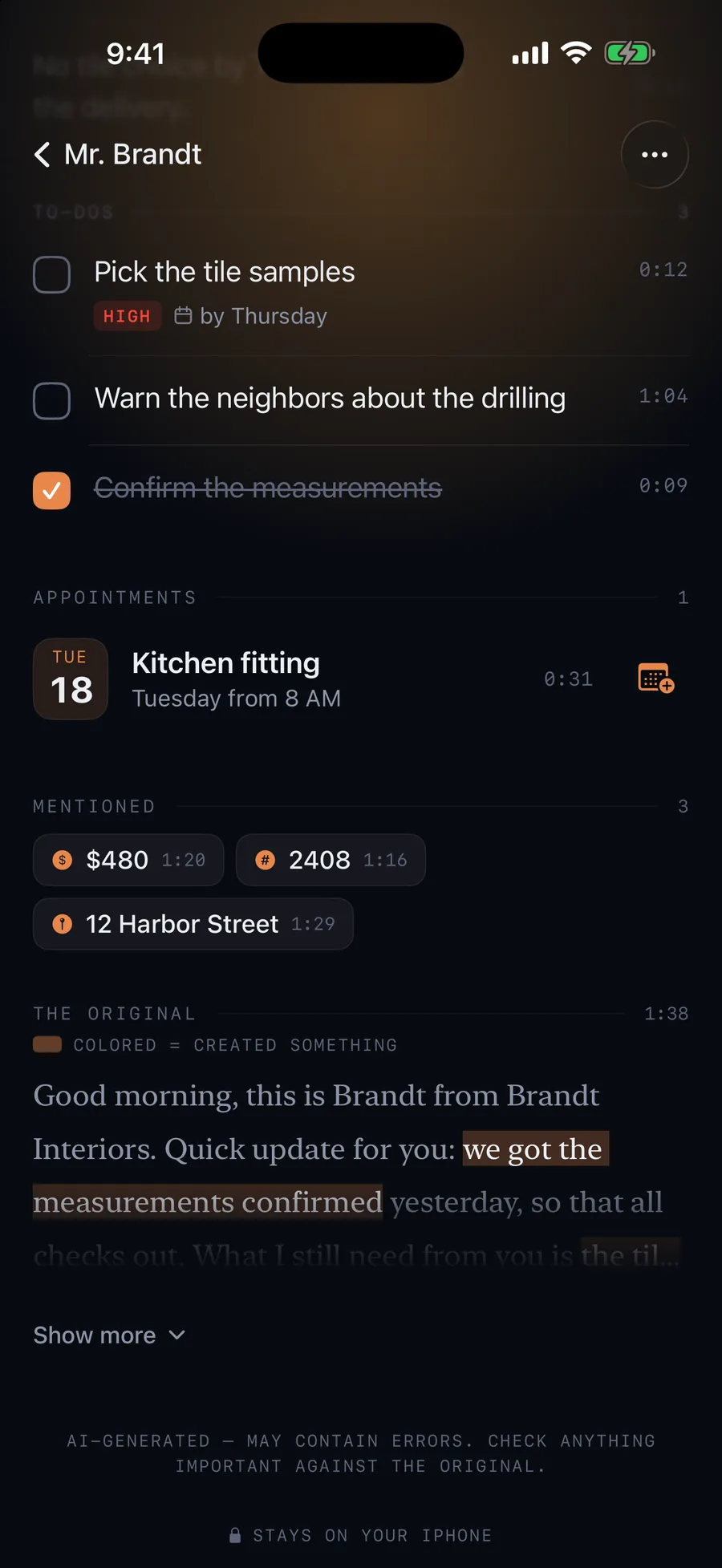
What VoiceClue finds in a message
Every analysis returns named parts, not just prose. Tasks get a due date and one of three priority levels. Appointments carry a title, a date and whether they run all day. Alongside them come the details that get lost on a second listen: people, phone numbers, amounts, places, invoice numbers, email addresses, dates and times.
This is not keyword matching. The due date shows the difference: VoiceClue does not merely remember that someone said “by Friday” — it works out the date, and keeps the original wording beside it. If you want to check later whether “Friday” really meant that Friday, the sentence is still there.
Three things that make the difference
When unsure, it asks instead of guessing
Not every sentence that sounds like a task is one. “I really should exercise more” does not belong on your list. When VoiceClue is not certain, the item arrives as a suggestion to confirm rather than quietly as a task — or it is quietly dropped.
Urgency carries its reason with it
Marking something urgent is worthless if you cannot see why. So VoiceClue stores the reason behind every rating and shows it. You decide whether to share it.
The calendar is only written to
You move a detected appointment across with one tap. VoiceClue has write access to your calendar — it cannot read it. Your other appointments stay outside, technically as well as in principle.
Every item knows where it came from
For each task and each appointment, VoiceClue stores the verbatim passage of the transcript it came from, together with its second in the recording. In the transcript it is colour-marked; one tap and you hear that exact moment in the speaker's own voice.
And when the passage could not be located with confidence, the mark is simply missing — rather than pointing somewhere. An absent source is honest; a wrong one would not be.
When the date is ambiguous
“Next Wednesday” is a surprisingly hard sentence. Said on a Wednesday, it can mean tomorrow or the one a week away — and a language model does not reliably calculate weekdays, it estimates them. That is exactly where earlier versions came apart.
So the analysis is told today's weekday outright instead of having to derive it, and a second step checks the result. Where doubt remains, the due date stands there with the original wording rather than an invented date.
This is the unglamorous kind of work you never see in an app — except in the fact that an appointment does not land on the wrong day.
Nothing happens without you
VoiceClue does not add anything to your calendar on its own, does not tick anything off on its own, and sends nothing. Every hand-over is a tap from you. That sounds obvious, but it is a decision: with appointments, automation that is right ninety percent of the time creates more work than it saves.
Everything open, in one place
Tasks do not stay trapped in their message. The to-do filter gathers every open task from every analysis into one list — ticking off included. If three people sent you three messages, you get one list instead of three audio tracks.
The next message with a deadline buried in it is coming.
Let it be the first one where the task falls out by itself.
Für iPhone · Gratis laden · Android folgt